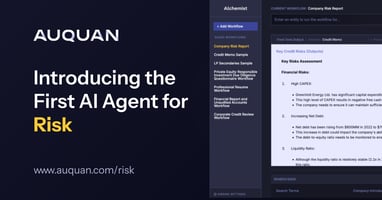
Today, we’re announcing the launch of our newest AI agent: the Credit Agent. This is the first and...
The memory you build around your model is your competitive edge – and is worth the investment.
Every fund and firm is running pilots on the same three or four foundation models. If your underwriting team has access to GPT-5, so does your competitor's. If your diligence process runs on Claude, so does the shop across the street bidding on the same deal.
In practice, that’s fine; the model was never going to be the differentiator. But it won’t help you deliver an edge through your AI strategy,
Palantir CEO Alex Karp made a related argument recently about enterprise AI. He touted that companies are spending heavily on tokens without proportional business value, and in doing so are outsourcing an important capability to a small number of Silicon Valley providers. His prescription is to own the infrastructure. And in Palantir's case, often literally the model weights.
Karp is poking the right holes.
But to deliver a truly differentiated AI strategy, you must figure out how to codify your judgment and unique ability to act on what only you know.
Boards and CEOs often measure AI progress by usage: how much is being spent, how many licenses are deployed, how many employees have adopted a tool.
Increasing usage is an easy metric because it's easy to report. But an organization can increase AI spend every quarter without becoming more capable, and that’s because usage and institutional capability are not the same thing.
It’s more useful for a leadership team to look at what the organization can do a year from now that it cannot do today.
Today’s markets are not the same as five years ago. The speed and efficiency of action necessary to remain competitive is 10x. The infrastructure and technology supporting deals need to support that.
And that’s fundamentally why AI is not just an IT problem. It’s now part of every decision we make across talent, technology risk, and competitive positioning. How organizations tackle AI internally determines whether it can remain relevant in the AI era.
Usage is just a small part of the puzzle. Alone, it cannot deliver a compounding advantage.
Karp argues that the fix is control of the infrastructure. You bring the models in-house. That conflates two different risks.
The first is data risk. Is proprietary information being used to train someone else's model? That risk could be solved commercially. Leading providers might offer contractual guarantees that enterprise data isn't used for training. Your legal team can probably handle this concern with a “zero data retention” clause.
The second, and arguably more important, risk is dependency. Owning the infrastructure doesn't remove dependency. A firm that self-hosts a model still becomes dependent on how it configured that model, who has the expertise to maintain it, and how much it costs to change course later. A firm that uses a frontier provider's API can be equally locked in if its processes, prompts, and institutional workflows are built entirely around one vendor's particular behavior. Either path can leave an organization unable to change direction without an expensive rebuild.
Unless you’re a defense contractor or handling classified systems, you realistically don’t need to bring your infrastructure in-house. Your time is better spent on decisions elsewhere in your AI strategy.
There are three pieces to your durability profile: Institutional memory, governance, and organizational investment.
Institutional memory: The judgment, standards, and decision logic you’ve refined over decades should not live inside a vendor's product. If it does, that knowledge must be rebuilt from scratch every time the firm changes providers.
Governance that you’re not outsourcing: As AI takes on more consequential work, leadership needs to be able to explain... to a board, an investor, a regulator... how a given conclusion was reached. This level of understanding requires the organization to own its evaluation standards, independent of whichever provider it happens to be using at that moment. This is a governance and trust question as much as a technical one, and it's one leadership will increasingly be asked about directly.
The organizational investment in changing how people work: Access to powerful models doesn't automatically make an organization faster or output better. Improvements only happen if leadership is willing to redesign how work gets done.
A disciplined, adaptable, and defined approach to AI will ensure that your strategy is durable – it can withstand the winds of change in technology, markets, and organizations.
Karp is right that the current path, i.e., heavy token spend without necessary memory investment and change management, is a strategic risk. He’s also right that many companies are ceding more control than they realize to model providers.
But this is a leadership decision about lasting infrastructure the organization is deliberately building for itself, independent of any single AI provider. Paving a path for a very near future where human and agentic employees work side by side.
Here’s the question I’ll leave you with: If every AI vendor your firm uses today disappeared tomorrow, would your organization's judgment, standards, and institutional knowledge still be standing?
If the answer is no, you don’t yet have a defensible AI strategy.
Each day we spotlight under-the-radar investment themes and idiosyncratic risks pulled from our intelligence engine, often involving emerging markets, supply chain issues, ESG risks, and the impact of regulatory changes.
Today, we’re announcing the launch of our newest AI agent: the Credit Agent. This is the first and...
StartupHub’s Daniel Singer this week published a deep dive into how foundation models and agentic...
Today, Auquan announced launch of Risk Agent, the first and only AI agent that autonomously...
Each day we spotlight under-the-radar investment themes and idiosyncratic risks pulled from our intelligence engine, often involving emerging markets, supply chain issues, ESG risks, and the impact of regulatory changes.
15 minutes to see what’s possible when manual work disappears.
Interested in working at Auquan? Click here
The memory you build around your model is your competitive edge – and is worth the investment.
Every fund and firm is running pilots on the same three or four foundation models. If your underwriting team has access to GPT-5, so does your competitor's. If your diligence process runs on Claude, so does the shop across the street bidding on the same deal.
In practice, that’s fine; the model was never going to be the differentiator. But it won’t help you deliver an edge through your AI strategy,
Palantir CEO Alex Karp made a related argument recently about enterprise AI. He touted that companies are spending heavily on tokens without proportional business value, and in doing so are outsourcing an important capability to a small number of Silicon Valley providers. His prescription is to own the infrastructure. And in Palantir's case, often literally the model weights.
Karp is poking the right holes.
But to deliver a truly differentiated AI strategy, you must figure out how to codify your judgment and unique ability to act on what only you know.
Boards and CEOs often measure AI progress by usage: how much is being spent, how many licenses are deployed, how many employees have adopted a tool.
Increasing usage is an easy metric because it's easy to report. But an organization can increase AI spend every quarter without becoming more capable, and that’s because usage and institutional capability are not the same thing.
It’s more useful for a leadership team to look at what the organization can do a year from now that it cannot do today.
Today’s markets are not the same as five years ago. The speed and efficiency of action necessary to remain competitive is 10x. The infrastructure and technology supporting deals need to support that.
And that’s fundamentally why AI is not just an IT problem. It’s now part of every decision we make across talent, technology risk, and competitive positioning. How organizations tackle AI internally determines whether it can remain relevant in the AI era.
Usage is just a small part of the puzzle. Alone, it cannot deliver a compounding advantage.
Karp argues that the fix is control of the infrastructure. You bring the models in-house. That conflates two different risks.
The first is data risk. Is proprietary information being used to train someone else's model? That risk could be solved commercially. Leading providers might offer contractual guarantees that enterprise data isn't used for training. Your legal team can probably handle this concern with a “zero data retention” clause.
The second, and arguably more important, risk is dependency. Owning the infrastructure doesn't remove dependency. A firm that self-hosts a model still becomes dependent on how it configured that model, who has the expertise to maintain it, and how much it costs to change course later. A firm that uses a frontier provider's API can be equally locked in if its processes, prompts, and institutional workflows are built entirely around one vendor's particular behavior. Either path can leave an organization unable to change direction without an expensive rebuild.
Unless you’re a defense contractor or handling classified systems, you realistically don’t need to bring your infrastructure in-house. Your time is better spent on decisions elsewhere in your AI strategy.
There are three pieces to your durability profile: Institutional memory, governance, and organizational investment.
Institutional memory: The judgment, standards, and decision logic you’ve refined over decades should not live inside a vendor's product. If it does, that knowledge must be rebuilt from scratch every time the firm changes providers.
Governance that you’re not outsourcing: As AI takes on more consequential work, leadership needs to be able to explain... to a board, an investor, a regulator... how a given conclusion was reached. This level of understanding requires the organization to own its evaluation standards, independent of whichever provider it happens to be using at that moment. This is a governance and trust question as much as a technical one, and it's one leadership will increasingly be asked about directly.
The organizational investment in changing how people work: Access to powerful models doesn't automatically make an organization faster or output better. Improvements only happen if leadership is willing to redesign how work gets done.
A disciplined, adaptable, and defined approach to AI will ensure that your strategy is durable – it can withstand the winds of change in technology, markets, and organizations.
Karp is right that the current path, i.e., heavy token spend without necessary memory investment and change management, is a strategic risk. He’s also right that many companies are ceding more control than they realize to model providers.
But this is a leadership decision about lasting infrastructure the organization is deliberately building for itself, independent of any single AI provider. Paving a path for a very near future where human and agentic employees work side by side.
Here’s the question I’ll leave you with: If every AI vendor your firm uses today disappeared tomorrow, would your organization's judgment, standards, and institutional knowledge still be standing?
If the answer is no, you don’t yet have a defensible AI strategy.
Each day we spotlight under-the-radar investment themes and idiosyncratic risks pulled from our intelligence engine, often involving emerging markets, supply chain issues, ESG risks, and the impact of regulatory changes.
Today, we’re announcing the launch of our newest AI agent: the Credit Agent. This is the first and...
StartupHub’s Daniel Singer this week published a deep dive into how foundation models and agentic...
Today, Auquan announced launch of Risk Agent, the first and only AI agent that autonomously...
15 minutes to see what’s possible when manual work disappears.
Interested in working at Auquan? Click here